Word-hyphenations
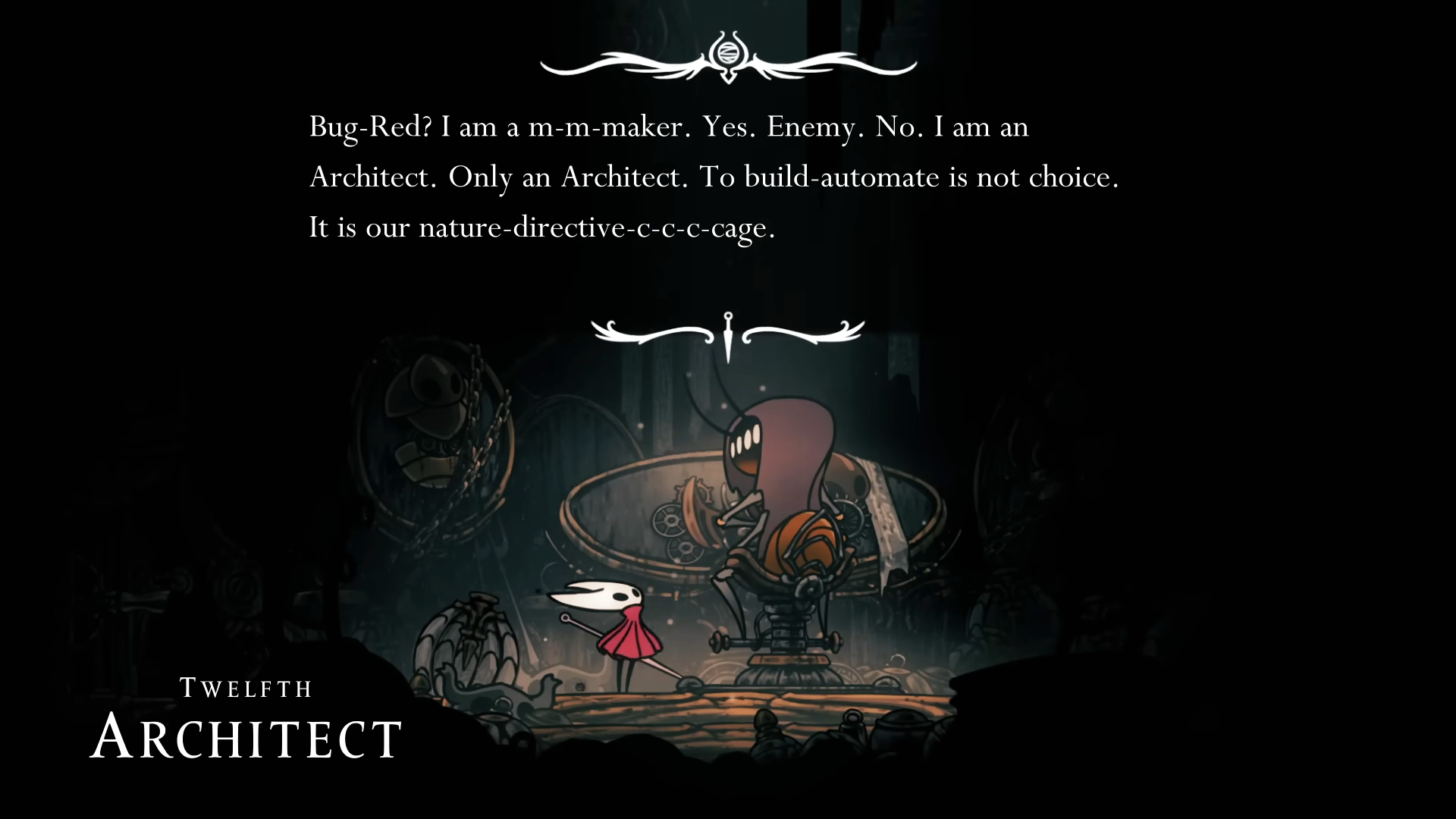
Recently I played Hollow Knight: Silksong, and a specific NPC caught my attention: the Twelfth Architect, canonically an mechanical being created to make other mechanical automations, and the last of their kind in a dying kingdom. I am neither of those things (unfortunately), but somehow I found the way they speak strangely familiar, especially the frequent use of hyphenations.
I think their language goes beyond the stereotypical "nerdy genius stuttering at words" image one might first get. To me the hyphenated word-composites make a lot of sense; each individual words adds a new layer of meaning to the composite, and together they make the expression more specific, rather than more vague.
Take the "build-automate" in their dialogue above, which the Twelfth Architect uses to describe their task. "Automate" certainly has the meaning of "build", but "automate" alone can give the sense of "improving existing operations" and doesn't really emphasis the innovative & hands-on "maker" idea that comes more naturally with "build".
The other examples in the screenshot is even more fascinating: "nature-directive-cage", describing the Architects' own compulsion to make. It strains my own vocabulary and command of language, but I try my best here to highlight the subtle differences in meaning. We see a spectrum of "innate" vs. "external": "nature" indicates the Architects are created with the inherent desire/tendency to make; "directive" focus more on making as an objective given to the Architects, suggesting high powers at play, potentially their creator; "cage" emphasize the limitation in their actions as being placed upon them, and could even hints at subtle dissatisfaction and internal conflict[1]. Together, this concoction-of-words approach is a strangely concise format for expression a whole degree of meaning, especially when considered in context.
Some more examples that I won't breakdown, but hopeful give a fuller idea of hyphenations are used:
"You have affinity for such radial blades? I can b-build upon the idea-knowledge."
"[...] for Pharloom's first children, a-a-a-and our kingdom-eternal, I shall serve."
"[...] though my own mind-directives may produce u-u-u-unique result."
I think these uses of hyphenations or word compounds resonated with me in my own use of language. It's currently PhD app season and I've gotten a lot of wonderful opportunities to struggle at writing. One particular struggle is this: I often find myself trying to express a specific idea that just doesn't quite line up with any single word; I'd usually resort to using a bunch of words and get an "average" meaning, or a whole grammatically-correct phrase just to describe this simple concept in my head. I end up saying stuff like "live/interactive/immediate debugging" or "valuable/fortunate/privileged opportunity" or "small/coarse/proxy optimization", which I think gives a bit of Twelfth Architect vibes.
I'll give an analogy to shows some aspects of the struggle. Let's say I'm a matric-system person living in an imperial-system-speaking country. I go to my local coffee roastery looking to buy 2 kilograms of coffee beans, but nobody speaks kilograms around here so I'll have to convert it to pounds. Now 2kg is exactly 4.409 pounds, but I can't just go up and be like "I want 4.409 pounds of beans", I'd look crazy. If I give a range like "4-5 pounds" I'd sound vague (even when I have an precise idea in mind), and if just ask for 4 pounds then I'd get 4 pounds, which is ok but a bit less than what I wanted. There's a subtle mismatch between what I think and what I can express with language, and it imposes a tradeoff between precision and concision.
If you're reading this the whole time thinking "just language better" then you'd be correct, but also beside the point. I don't claim this problem to be unique/novel; actually I think it is precisely a skill part of general language master and good writing, and I've just become more conscious of this very formulation I've described thanks to the game Silksong. In the end, some part of me secretly hopes that word-hyphenations can one day becomes normal in standard English.
Afterthought
Another related struggle that I observed, as someone equally comfortable in two languages, is when talking in language A and coming across that one thought which has a perfect word for it in language B but no good counterpart in A. If you talk to me in person and I suddenly stop mid-sentence with a strained expression, 80% of the time it's that I've found a perfect language B word but cannot say it in language A. I wonder if polyglots have it way worse.
Maybe one could frame the problem this way: all widely-used languages are probably "Turing complete", i.e. they can express any human idea to arbitrary precision, given enough length. But their differences lie in conciseness in expressing each individual idea.
Dec. 1, 2025
| [1] | you can get into the determinism debate with "aren't we all slaves to our nature?" which I'd love to write several more pages on but unfortunately it's not the right place and time for it. Though in my headcanon the Twelfth Architect has probably thought about these philosophical questions at some point, based on the degree of self-reflection shown here. |